- English
- French
- German
- Portuguese
- Spanish
- Russian
- Japanese
- Korean
- Arabic
- Greek
- German
- Turkish
- Italian
- Danish
- Romanian
- Indonesian
- Czech
- Afrikaans
- Swedish
- Polish
- Basque
- Catalan
- Esperanto
- Hindi
- Lao
- Albanian
- Amharic
- Armenian
- Azerbaijani
- Belarusian
- Bengali
- Bosnian
- Bulgarian
- Cebuano
- Chichewa
- Corsican
- Croatian
- Dutch
- Estonian
- Filipino
- Finnish
- Frisian
- Galician
- Georgian
- Gujarati
- Haitian
- Hausa
- Hawaiian
- Hebrew
- Hmong
- Hungarian
- Icelandic
- Igbo
- Javanese
- Kannada
- Kazakh
- Khmer
- Kurdish
- Kyrgyz
- Latin
- Latvian
- Lithuanian
- Luxembou..
- Macedonian
- Malagasy
- Malay
- Malayalam
- Maltese
- Maori
- Marathi
- Mongolian
- Burmese
- Nepali
- Norwegian
- Pashto
- Persian
- Punjabi
- Serbian
- Sesotho
- Sinhala
- Slovak
- Slovenian
- Somali
- Samoan
- Scots Gaelic
- Shona
- Sindhi
- Sundanese
- Swahili
- Tajik
- Tamil
- Telugu
- Thai
- Ukrainian
- Urdu
- Uzbek
- Vietnamese
- Welsh
- Xhosa
- Yiddish
- Yoruba
- Zulu
How to Use Fosthiazate Nematicide for Root-Knot Nematodes
share:
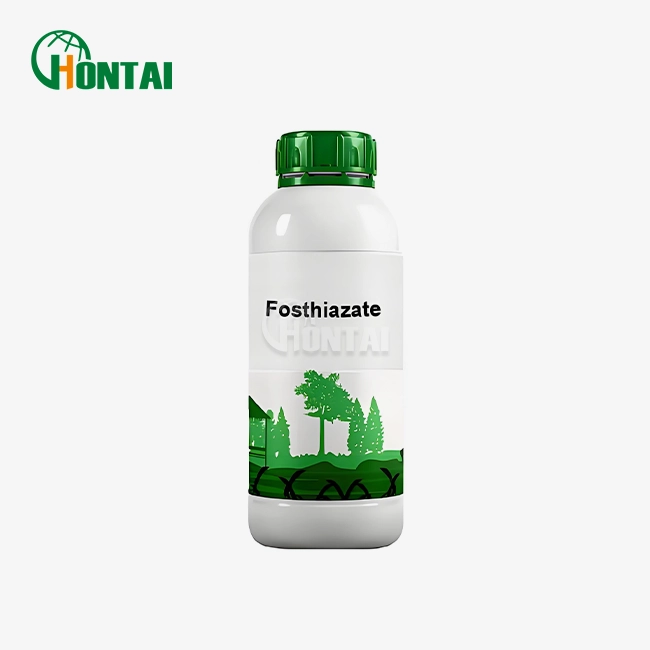
Root-knot nematodes are amongst the most damaging soil-borne illnesses in commercial agriculture, with an estimated loss of $157 billion a year in crops worldwide. Fosthiazate nematicide has considerable benefits in the control of these little trespassers. Fosthiazate is a soil treatment applied pre- or at-transplant. It functions by inhibiting the action of the enzyme acetylcholinesterase in the nematode’s nervous system, therefore interfering with normal nerve signalling and motility. Recommended rates range from 3 to 10 kg active ingredient per hectare depending on the intensity of pest pressure and kind of crop. Its systemic absorption and residual activity in soil make it a dependable weapon in any big root-knot nematode management campaign.

Understanding Fosthiazate and Its Mode of Action
Fosthiazate is an organophosphate chemical nematicide, (RS)-S-sec-butyl O-ethyl 2-oxo-1,3-thiazolidin-3-ylphosphonothioate. Unlike other soil pesticides that work only by contact, this substance translocates via plant tissue and the soil matrix to target nematodes at different depths.
How It Disrupts Nematode Biology?
The chemical permanently binds to acetylcholinesterase, an enzyme animals need to convey information via their nerves. When nerve impulses stop, they build up, causing continuous muscle spasms which impede movement and normal biological activity frequently within 24 to 72 hours of exposure. This strategy also explains why it is so effective against a broad spectrum of pests both above and below the ground, such as thrips, moth larvae, beetles and flies. This makes it a multi-pest tool, not a one-target fix.
Broad-Spectrum Soil Activity
Fosthiazate is also effective against acarina mites residing in soil and several root pests developing beneath the earth, besides nematodes. It is also still quite effective against insect populations that have evolved resistance to carbamate and pyrethroid pesticides. This gives it a distinct advantage in companies that have a history of using traditional pesticides.
Best Practices for Application
The return of investment is directly proportionate to the usage of nematicide. These are the methods used by large-scale vegetable farmers in Southeast Asia, Africa and Latin America that have been tested in the field.
Here are the fundamental application ideas that determine the performance results:
- Pre-Plant Soil Incorporation: Incorporate dirt by hand at least 5-7 days prior to plant relocation. Fosthiazate nematicide granules or liquid formulations should be broadcast over the top 15-20 cm of soil. The distribution window is wide enough to provide for adequate touch and moisture to the dirt to begin developing roots before they take hold.
- Directed drench during transplanting: Tomato and cucumber crops will be extensively saturated in the root zone by a directed drench into the transplant hole at the rate of 5–7.5 kg a.i./ha. This is especially good on sandy or clay soils that do not hold water well.
- Soil moisture timing: There should be sufficient soil moisture for optimal diffusion of fosthiazate. Field experiments at the nematology department of the University of Florida suggest that application to dry or wet soils may reduce absorption and effectiveness by as much as 30%.
- Requirements for handling the product: The application crew should follow product label guidelines for handling and application procedures. You may re-enter in most cases 12 to 48 hours following application; however, this may be shorter or longer depending on regulations in your country.
They are not add-ons to be disregarded; they are what make the difference between controlling nematodes some of the time or all of the time. For B2B customers, the key is to ensure that these features are sufficiently disclosed in the supplier’s technical data sheets for fosthiazate nematicides items.
Comparing Fosthiazate with Other Nematicide Options
There are both chemical and organic nematicides on the market, and each has its own pros and cons. Figuring out where fosthiazate fits in this picture helps buying teams make decisions that they can back up.
Chemical Alternatives
Both aldicarb and oxamyl are acetylcholinesterase inhibitors, but their regulatory classifications differ from fosthiazate, which is in WHO Class II. Fenamiphos used to be a standard on the market, but more and more rules are making it illegal in the EU and some African markets. Fosthiazate is a good compromise because it has strong systemic action, a wider range of pests it controls, and a relatively well-characterised product profile.
Biological and IPM Integration
Biological nematicides based on Bacillus firmus or Purpureocillium lilacinum offer an alternative approach, but they need to be used more than once and reduce the population more slowly. As part of an integrated pest management plan, a fosthiazate nematicide is used to get rid of pests, and organic agents keep them down while the crop grows. This rotation also lowers the chance of resistance building up, which is a big problem in fields that are exposed to nematicides over and over again.
Procurement Guide: Sourcing Fosthiazate at Scale
There are more factors to consider than just price per kilogram when looking for nematicide. When it comes to professional buying, a reliable supply, accurate paperwork, and consistent composition all matter.
Key Supplier Evaluation Criteria
When vetting a fosthiazate nematicide supplier or manufacturer, prioritise these verification points:
- Active ingredient purity: Technical concentrate must be at least 90% pure, as shown by GC or HPLC testing that is included in a current Certificate of Analysis.
- Formulation stability data: Accelerated storage tests at 54°C for 14 days should show that the active ingredient stays above 95% of its label content, which is important for storage conditions in tropical and subtropical areas.
- Registration documentation support: Reliable providers offer MSDS, bioefficacy trial data, and GLP study results to back up product registration in key markets.
- MOQ flexibility: When B2B buyers enter new markets, it helps when sellers let them try out small batches before they commit to business shipments of 5–20 tonnes.
Standard payment terms for this type of goods are T/T with a 30% deposit when the order is confirmed and the remaining 70% due before the goods are shipped, or L/C at sight for government tender supply contracts.
Field Performance: What Growers Report?
The usefulness of fosthiazate in real life is supported by evidence from industrial vegetable production activities. Meloidogyne incognita-infested tomato fields in Kenya were used in a study that showed pre-plant inclusion at 7.5 kg a.i./ha led to a 42% decrease in root gall index and an 18% increase in yield compared to untreated controls. Growers of cucumbers in Indonesia who took part in a collaborative extension programme said that adding fosthiazate to a three-season IPM rotation had the same effects: fewer replant penalties and longer growing seasons.
The results here are not unusual. The compound's stability in different soil types and temperatures is shown by consistent results in a wide range of settings. This is very important for wholesalers who are sending goods to Africa, Southeast Asia, and Latin America all at the same time.
Conclusion
Root-knot nematodes need to be controlled with chemicals that have broad reach, residual action, and the ability to work on a wide range of pests. All three of these things are done by fosthiazate nematicide, and its established application profile means it can be used in sensible crop protection measures. Adding fosthiazate to your soil health plan has been shown to improve performance, whether you are in charge of a big food farm or a regional network that distributes agrochemicals. The most consistent value from this active ingredient will come from procurement teams that know about application protocols, supplier documentation requirements, and IPM positioning.
FAQ
1. Is fuchsite safe to use near water sources?
Fosthiazate nematicide has established use requirements around aquatic areas, and buffer zones of 10 to 20 metres are usually needed around bodies of water as part of approved use standards. Before using something near natural or irrigation canals, you should always check the area label and talk to the regional environmental authority.
2. How long does fosthiazate remain active in the soil?
Based on field half-life data, fosthiazate stays in the soil for about 20 to 40 days in normal temperate conditions. In warmer tropical soils with more microbes, degradation happens faster, so applying the chemicals at the right time, during the early stages of crop establishment, gives nematodes the most opportunities to get exposed.
3. Can fosthiazate be used on organic-certified farms?
No, fosthiazate is not organic according to any important standard, such as the USDA NOP or the EU Regulation 2018/848. It is a man-made organophosphate. Before they can get certified as organic, farms that are changing their status must go chemical-free for certain amounts of time.
4. What crops are typically registered for fuchsite use?
In most places, registered use includes growing tomatoes, cucumbers, peppers, potatoes, and a number of decorative plants. The state of registration varies by country, so always check with the national agency in charge of pesticides before buying anything.
Source Fosthiazate Nematicide Through Hontai—Request a Quote Today
Hontai is a trusted source for fosthiazate nematicide because they have strict batch quality control, variable MOQ structures, and full documentation packages. It has been making agrochemicals and fosthiazate nematicides for a long time, and Hontai helps distributors, OEM brand owners, and big farm operations with GMP-compliant goods, custom label choices, and 15–30 day global logistics. Reach our technical team directly at admin@hontai-biotech.com to request pricing, samples, or a full COA package.
References
1. Chitwood, D. J. (2003). Nematicides. Encyclopedia of Agrochemicals, John Wiley & Sons.
2. Goverse, A., & Smant, G. (2014). The activation and suppression of plant innate immunity by parasitic nematodes. Annual Review of Phytopathology, 52, 243–265.
3. Sasser, J. N., & Freckman, D. W. (1987). A world perspective on nematology: The role of the society. Vistas on Nematology, Society of Nematologists.
4. Greco, N., & Di Vito, M. (2009). Population dynamics and damage levels. Root-Knot Nematodes, CABI Publishing.
5. Haydock, P. P. J., Woods, S. R., Grove, I. G., & Hare, M. C. (2006). Chemical control of nematodes. Plant Nematology, CABI Publishing, 392–410.
6. Stirling, G. R. (2014). Biological Control of Plant-Parasitic Nematodes: Soil Ecosystem Management in Sustainable Agriculture (2nd ed.). CABI Publishing.

Our customers’ satisfaction speaks for our quality — contact us to experience the same reliable service.