- English
- French
- German
- Portuguese
- Spanish
- Russian
- Japanese
- Korean
- Arabic
- Greek
- German
- Turkish
- Italian
- Danish
- Romanian
- Indonesian
- Czech
- Afrikaans
- Swedish
- Polish
- Basque
- Catalan
- Esperanto
- Hindi
- Lao
- Albanian
- Amharic
- Armenian
- Azerbaijani
- Belarusian
- Bengali
- Bosnian
- Bulgarian
- Cebuano
- Chichewa
- Corsican
- Croatian
- Dutch
- Estonian
- Filipino
- Finnish
- Frisian
- Galician
- Georgian
- Gujarati
- Haitian
- Hausa
- Hawaiian
- Hebrew
- Hmong
- Hungarian
- Icelandic
- Igbo
- Javanese
- Kannada
- Kazakh
- Khmer
- Kurdish
- Kyrgyz
- Latin
- Latvian
- Lithuanian
- Luxembou..
- Macedonian
- Malagasy
- Malay
- Malayalam
- Maltese
- Maori
- Marathi
- Mongolian
- Burmese
- Nepali
- Norwegian
- Pashto
- Persian
- Punjabi
- Serbian
- Sesotho
- Sinhala
- Slovak
- Slovenian
- Somali
- Samoan
- Scots Gaelic
- Shona
- Sindhi
- Sundanese
- Swahili
- Tajik
- Tamil
- Telugu
- Thai
- Ukrainian
- Urdu
- Uzbek
- Vietnamese
- Welsh
- Xhosa
- Yiddish
- Yoruba
- Zulu
Is Pymetrozine 50%WG Safe for Integrated Pest Management?
share:
Pymetrozine 50% WG is effective—it is a selective insecticide for today’s IPM programs. This water-dispersible granule formulation is the only member of the pyridine azomethine chemical family that can target sap-feeding pests with accuracy, and it is designed for selective control of sap-feeding pests in crop protection programs. It is supported by field data and regulatory studies and is compatible with IPM frameworks in rice, vegetables, cotton, and fruit crops. For distributors of agrochemicals and large-scale producers looking for a solid, science-based solution, the answer is simple: Yes, pymetrozine 50% WG is suitable for integrated pest control.

Understanding Pymetrozine 50% WG: Mode of Action and Safety Profile
How Pymetrozine Disrupts Pest Feeding Behavior?
Pymetrozine 50% WG is a representative of the group of pyridine azomethines. This group is unaffected by organophosphates, carbamates, and neonicotinoids. It has a unique mode of action; it inhibits the muscles of the stylet of phloem-feeding insects, preventing them from penetrating plant tissue. Rice brown planthoppers, whiteflies, and aphids cease feeding within hours of exposure, long before they die. This measure is important in the protection of vegetable and fruit crops, preventing the spread of plant viruses.
It has a chemical composition of C₁₀H₁₁N₅O. It is produced and registered worldwide under such trademarks as "Chess," "Fulfil," "Relay," "Sterling," and "Plenum." Hontai’s formulation is 97% technically pure, and the Pymetrozine 50% WG is a dust-free, water-dispersible grain form that dissolves fast for consistent results in all settings.
Environmental Safety and Regulatory Standing
The regulatory profile of Pymetrozine 50% WG has been reviewed by many regulatory organizations. According to research, it has been evaluated in relation to honeybees and green lacewing Chrysoperla spp. and parasitoid wasps, which are beneficial insects that are important in IPM systems. Based on aquatic life studies, its environmental profile has been evaluated for agricultural use. The product should be maintained in a cold, dry environment and has a shelf life of two to three years, which is simple for distributors to manage across extensive supply chains throughout Africa, Southeast Asia, and Latin America.
Comparing Pymetrozine 50% WG with Alternative Pest Control Solutions
Pymetrozine vs. Neonicotinoids: A Practical Comparison
In most areas, Pymetrozine 50% WG is not restricted and may be used in spray programs with biological control agents. The WG version is also simpler to handle than the liquid variants. The key things to consider in procurement decisions are
- Pymetrozine 50% WG and Pymetrozine 20% SC: The WG formulation contains more active ingredient per kilogram, reducing packaging and freight costs per effective dosage—a big benefit for bulk purchasers dealing with shipments of 5-20 tonnes.
- Pymetrozine 50% WG versus Imidacloprid 70% WG: Pymetrozine 50% WG has a different profile for bee exposure and is compatible with pollinator management programs used in several EU export supply chains.
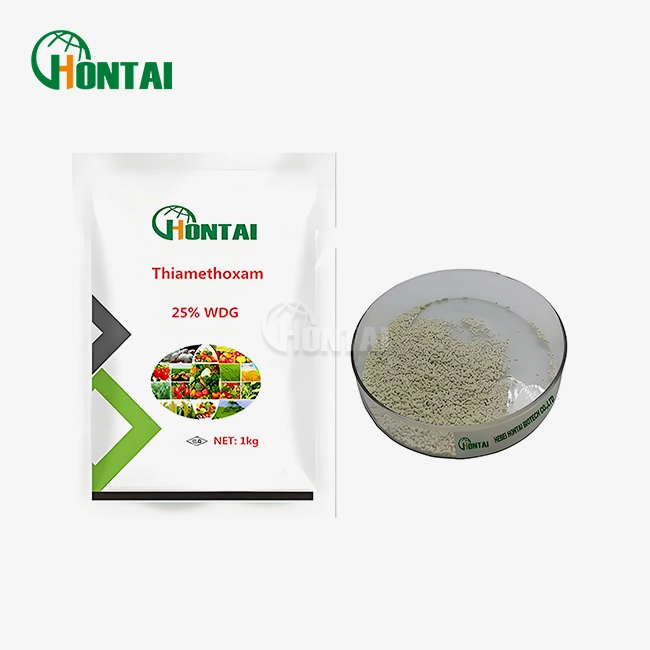
- Pymetrozine 50% WG with Thiamethoxam 25% WG: When sprayed at the same rate, Pymetrozine 50% WG is as excellent as or better than thiamethoxam at controlling planthoppers and can be considered for crop protection programs targeting markets with rigorous MRL requirements such as Japan and South Korea.
- Pymetrozine 50% WG—Instructions for Safe and Effective Usage Information on Application Rates, Timing, and Tank Mixing
Safe and Effective Usage Instructions for Pymetrozine 50% WG
Application Rates, Timing, and Tank Mix Guidance
The ideal time to apply it is determined by the level of insect numbers, crop stage, and the geographical dynamics of the pest population. It is a general field recommendation to apply it early in the infection, before the colony is established, so as to benefit from the antifeeding process before the population increases. For most foliar applications, the recommended rate is 100 to 200 grams of product per hectare; however, the specific dosage will depend on local registration restrictions.
Pymetrozine 50% WG may be used in combination with most fungicides, such as azoxystrobin and tebuconazole, which are neutral to slightly acidic. Do not combine with extremely alkaline materials such as the Bordeaux combination, as it will decrease the stability of the active ingredient. The WG formulation produces very little foam and has suspensibility rates of 90% or higher, ensuring constant performance in mechanical agitation systems and drone spray equipment, a need for large farms using UAV technology. Activity is validated by evaluating the reaction of the plant 3-5 days after treatment. In the field, observations include withering of clusters of pests and cessation of honeydew production. Under typical settings, crop performance can be monitored after application.
Procurement Insights: Where and How to Source Quality Pymetrozine 50% WG?
Verifying Supplier Quality Before Committing to Volume
China’s agrochemical industry, headquartered in the provinces of Hebei, Anhui, and Jiangsu, produces the majority of the world’s pymetrozine 50% WG technical concentrate. However, documentation and uniformity differ from maker to manufacturer. Buyers should look for providers that can supply a COA validated by HPLC showing a technical purity of ≥97% and two years of accelerated stability data under the circumstances of 50°C/75% RH.
Pymetrozine 50% WG, Hebei Hontai Biotech Co., Ltd., Shijiazhuang, Hebei. Pymetrozine 50% WG is manufactured in accordance with GMP. They provide adaptable packaging adapted to the demands of clients, including HDPE containers, bespoke label printing, and MOQ structures that accommodate registration-trial samples and commercial shipments. MSDSs, formulation stability data, and bioefficacy trial results are expected to be submitted by the suppliers prior to approval.
Integrating Pymetrozine 50% WG into Your IPM Strategy for Sustainable Success
Rotation Scheduling and Resistance Management
For best IPM, alternate Pymetrozine 50% WG with insecticides with different IRAC mode of action groups. In the management of rice planthopper, for example, IRAC Group 9B is rotated with Group 6 or Group 28 during the tillering-to-booting stage. It’s a way to delay the onset of resistance and sustain the pressure on pests all season long.”
Field trials in Vietnam and Indonesia have shown the effective integration of Pymetrozine 50% WG into rice IPM programs, in combination with Trichoderma-based soil treatments and pheromone monitoring systems. These initiatives demonstrate that the overall pesticide input has decreased while maintaining yield protection criteria. Since the substance has been evaluated for its effects on natural enemies, predator populations can be monitored between sprayings to support biological control. Its selective mode of action makes it a useful instrument for 21st-century integrated pest control.
Conclusion
Pymetrozine 50% WG is an important component of IPM programs because of its excellent selectivity and innovative method of action against target pests. Its dust-free WG formulation is simpler to handle and carry than liquid solutions, and its chemistry breaks down pest resistance, which is becoming an issue as neonicotinoid-resistant bugs increase. Whether you're working on rice farms in Southeast Asia, vegetable supply lines in Africa, or export-grade cotton in Latin America, it’s a scientifically proven and commercially feasible option for sustained pest management.
FAQ
1. What pests does Pymetrozine 50% WG control?
Pymetrozine 50% WG targets sap-feeding insects, including aphids, whiteflies, and rice brown planthoppers. Records show it can be used on rice, vegetables, fruits, cotton, ornamentals, and hop crops.
2. How quickly does Pymetrozine 50% WG work?
Once pests contact the compound, they stop eating within hours. Visible population decline typically occurs within 3–5 days. The antifeeding action stops virus transmission even before mortality is observed.
3. Is Pymetrozine 50% WG safe for beneficial insects?
Research has evaluated the effects of Pymetrozine 50% WG on honeybees, predatory insects, and parasitoid wasps at field application rates, making it a strong candidate for IPM programs that rely on biological control agents.
4. What is the shelf life of Pymetrozine 50% WG?
When stored in a cool, dry place, the shelf life is 2–3 years. The solid WG state resists the stratification and precipitation issues that commonly affect liquid formulations during long-distance storage.
Source Pymetrozine 50% WG Directly from Hontai—Request a Sample Today
Hontai offers pymetrozine 50% WG with 97% technical purity, GMP-compliant documentation, and custom packaging tailored to your registration requirements. As a verified Pymetrozine 50% WG manufacturer based in Shijiazhuang, Hebei, we support clients from initial sampling through full commercial supply—with COA, MSDS, and stability data provided for every shipment. Contact our technical team at admin@hontai-biotech.com to request samples, pricing, or a product specification sheet.
References
1. Kayser, H., & Eilinger, P. (2001). Metabolism of pymetrozine by houseflies and other insects. Pest Management Science, 57(10), 975–980.
2. Nauen, R., Hungenberg, H., Tollo, B., Tietjen, K., & Elbert, A. (1998). Antifeedant effect, biological efficacy, and high-affinity binding of imidacloprid to acetylcholine receptors in Myzus persicae and Aphis gossypii. Pesticide Science, 53(2), 133–140.
3. Powell, G., Hardie, J., & Pickett, J. A. (1998). Effects of the antifeedant compound pymetrozine on aphid behavior. Entomologia Experimentalis et Applicata, 87(3), 285–290.
4. Gu, J., Li, J., Zhao, H., & Smagghe, G. (2013). Baseline susceptibility of the brown planthopper Nilaparvata lugens to pymetrozine in China. Pest Management Science, 69(10), 1235–1240.
5. International Rice Research Institute (IRRI). (2020). Integrated Pest Management for Rice: A Practical Manual. IRRI Publications.
6. Food and Agriculture Organization of the United Nations (FAO). (2021). International Code of Conduct on Pesticide Management: Guidelines on Resistance Management and Integrated Pest Management. FAO.
Our customers’ satisfaction speaks for our quality — contact us to experience the same reliable service.