- English
- French
- German
- Portuguese
- Spanish
- Russian
- Japanese
- Korean
- Arabic
- Greek
- German
- Turkish
- Italian
- Danish
- Romanian
- Indonesian
- Czech
- Afrikaans
- Swedish
- Polish
- Basque
- Catalan
- Esperanto
- Hindi
- Lao
- Albanian
- Amharic
- Armenian
- Azerbaijani
- Belarusian
- Bengali
- Bosnian
- Bulgarian
- Cebuano
- Chichewa
- Corsican
- Croatian
- Dutch
- Estonian
- Filipino
- Finnish
- Frisian
- Galician
- Georgian
- Gujarati
- Haitian
- Hausa
- Hawaiian
- Hebrew
- Hmong
- Hungarian
- Icelandic
- Igbo
- Javanese
- Kannada
- Kazakh
- Khmer
- Kurdish
- Kyrgyz
- Latin
- Latvian
- Lithuanian
- Luxembou..
- Macedonian
- Malagasy
- Malay
- Malayalam
- Maltese
- Maori
- Marathi
- Mongolian
- Burmese
- Nepali
- Norwegian
- Pashto
- Persian
- Punjabi
- Serbian
- Sesotho
- Sinhala
- Slovak
- Slovenian
- Somali
- Samoan
- Scots Gaelic
- Shona
- Sindhi
- Sundanese
- Swahili
- Tajik
- Tamil
- Telugu
- Thai
- Ukrainian
- Urdu
- Uzbek
- Vietnamese
- Welsh
- Xhosa
- Yiddish
- Yoruba
- Zulu
How To Get Rid Of Thrips Before They Wreck Your Plants
share:
Thrips are one of the absolute teeniest pests you may encounter in your garden. At less than 1/32 of an inch, or 1 mm, long, adults are barely visible without magnification. “You’ll probably notice plant injury before you see the insects themselves,” says Tim Bryant, PhD, assistant professor and extension specialist in the department of entomology at Virginia Tech. “There are many different species throughout the Southeast.”
Thrips attack numerous types of ornamental and edible plants, such as roses, tomatoes, onions, and garlic. “Some thrips are specific on the type of host plants they feed on, while the major pest species are polyphagous, meaning they feed on a variety of plants,” says Matt Bertone, PhD, director of the Plant and Disease Insect Clinic at North Carolina State University. “Often thrips are worst on plants in greenhouse, and indoors, where populations may explode. They can feed on leaves or flowers, or both, depending on the species.”
Thrips also can transmit serious plant viruses, including tomato spotted wilt virus, for which there is no cure, says Bryant. Affected plants should be removed and discarded immediately to prevent the spread to other garden plants.
How To Identify Thrips
The 1 to 2 mm-long adults are slender, with long, strap-like hairy wings. They are usually yellow or light brown, though some are gray, black, or black-and-white patterned. “They tend to squirm around and move erratically, hopping around, rather than flying, though they can fly and sometimes swarm,” says Bertone. Immature stages are even smaller and yellowish.
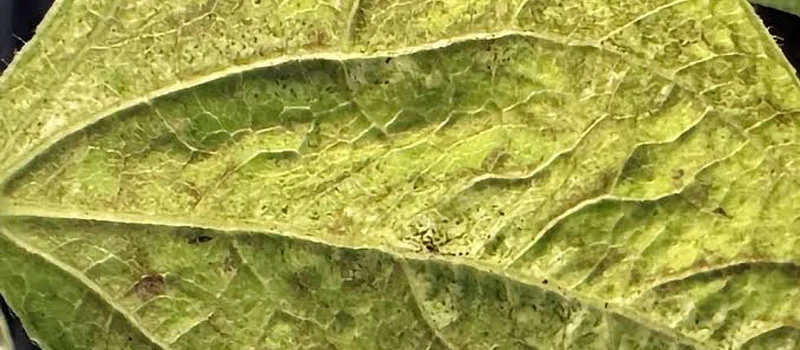
Thrips have rasping, sucking mouthparts. “Thrips damage is often characterized by areas of discolored tissue, usually silvery or white patches, due to them sucking on the tissue and removing the parts that make the plant green,” says Bertone. “They also can suck the color out of flowers, leaving small spots called ‘stippling.’ Flower damage may also show up as brown edges of the petals.” Some species cause distortion of the leaves.
Although other pests cause similar damage, thrips damage is often associate with numerous small flecks of dark green to black fecal matter. “They’re very messy when they feed,” says Bertone.
If you suspect the presence of thrips, you may be able to see them by using a magnifying glass to look for them, especially between petals and leaves. Or if a plant seems a little “off,” you can hold a white piece of paper beneath flowers and leaves and tap to dislodge these insects, says Bryant.
Another method is to take a plant cutting, place it in a container with alcohol and shake to dislodge and view them in the wash, says Bertone.
Understanding Thrips
Thrips are not super-strong fliers and often are dispersed by the wind, says Bryant. The females lay eggs in plant tissue. When the eggs hatch, the immature stages start feeding. Much of the injury is done by the immatures, says Bryant. The pupal stage, which does not feed on the plant, will drop down into the soil to develop and soon emerge as an adult to start the reproductive process all over again. Overlapping generations can occur during the season.


Our customers’ satisfaction speaks for our quality — contact us to experience the same reliable service.